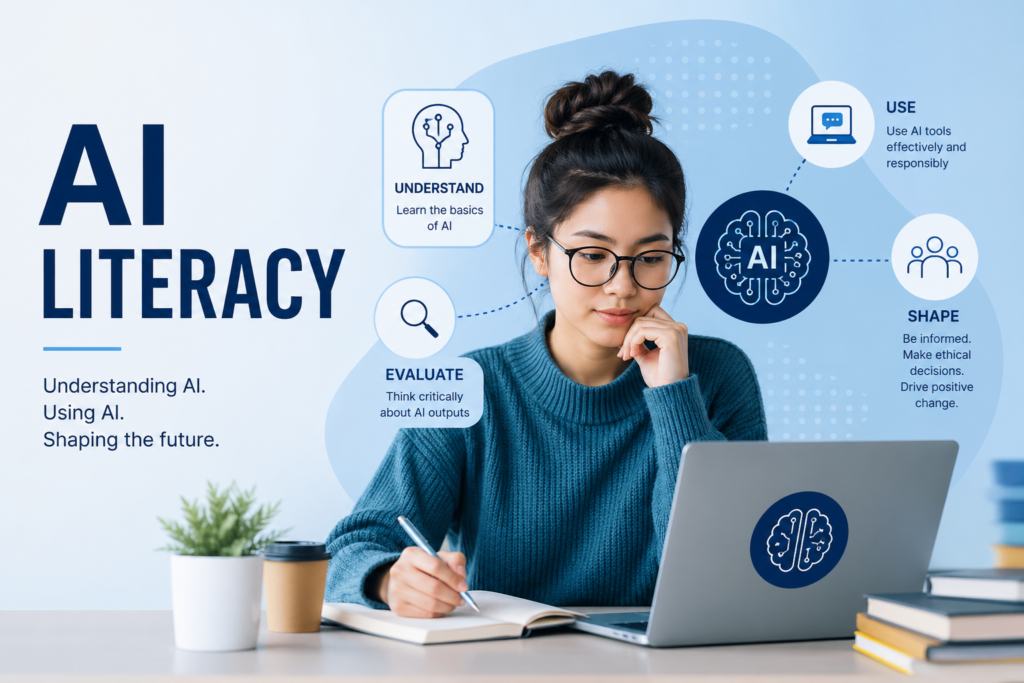
One thing is certain though; AI literacy is becoming a must-have.
That matters for marketers and business teams because AI literacy is not the same thing as “knowing how to use ChatGPT.” It is the ability to understand what an AI system is doing, use it deliberately, evaluate its outputs critically, and recognize the ethical, legal, and reputational risks that come with deploying it in real work. The European Commission’s guidance on Article 4 of the EU AI Act makes this especially concrete: providers and deployers of AI systems must ensure a sufficient level of AI literacy among staff and others using AI on their behalf, and that obligation has applied since 2 February 2025.
In other words, AI literacy is shifting from “nice to have” to operational necessity. For a marketing team, that means at least four things.
First, teams need conceptual understanding: what AI can do, what it cannot do, and how outputs are shaped by data, prompts, and model design.
Second, they need tool fluency: how to use AI for ideation, summarization, drafting, research support, and workflow acceleration without losing strategic control.
Third, they need critical evaluation: how to spot hallucinations, weak sourcing, factual drift, bias, and polished nonsense.
Fourth, they need ethical and governance awareness: privacy, copyright, disclosure, brand safety, fairness, and human oversight. These dimensions recur across the literature and policy guidance
“AI literacy includes understanding how AI works, how to use it, and how to evaluate its outputs critically. It also involves awareness of ethical implications and responsible use.”
One reason the concept is gaining traction so quickly is that the education research is no longer speculative. A 2025 Frontiers systematic review of higher-education reading and writing practices screened thousands of records and ended with 55 empirical studies on AI use in academic literacy. The review found that AI tools are already embedded in tasks such as grammar support, idea generation, paraphrasing, text organization, and formative feedback. A related 2026 synthesis reported gains in coherence, discursive organization, lexical richness, and argumentation, while also flagging overreliance, reduced metacognitive engagement, and integrity concerns.
Spillover Effects Beyond Literacy
That balance is important. The strongest research does not say AI is simply good or bad for literacy. It says AI can improve performance when it is integrated with guidance, reflection, and human judgment. The same pattern shows up in broader skills research. A 2025 Frontiers study on AI and learning skills found that students perceived AI tools as beneficial for self-directed learning, problem-solving, critical thinking, and digital literacy. A 2025 Nature review that mapped 335 AI-literacy-education articles from 2014 to 2024 found the field has moved from early exploration to rapid growth, with recurring themes around data literacy, machine learning, computational thinking, ethics, and practical application.
For marketers, this matters directly because modern marketing work is increasingly literacy work mediated by AI. Teams read faster, summarize more, draft more, research more, and produce more variants than ever. AI now sits inside content calendars, SEO workflows, customer research, campaign ideation, CRM messaging, and internal knowledge work. That creates productivity upside, but it also increases the cost of shallow use. A marketer who can generate ten options in thirty seconds but cannot evaluate claims, detect fabrication, or understand compliance risk is not AI-literate. They are merely AI-exposed.
Recent workplace signals reinforce that point. The WEF reports that AI and big data are among the fastest-growing skills, while another WEF piece notes that AI literacy skills such as prompt engineering and fluency with tools like ChatGPT or Copilot have become key differentiators; it also cites a sharp increase in AI-literacy-related skills added to LinkedIn profiles. The OECD, meanwhile, warns that training supply may not yet be sufficient to meet growing demand for general AI literacy.
Lorem ipsum dolor sit amet, consectetur adipiscing elit. Ut elit tellus, luctus nec ullamcorper mattis, pulvinar dapibus leo.Lorem ipsum dolor sit amet consectetur adipiscing elit dolor
How the Next Generation Uses AI
There is also growing evidence that AI-supported literacy is becoming normalized among younger users, which should matter to brands thinking about the next generation of employees and customers. The UK National Literacy Trust reported in 2025 that more than 60,000 young people and 2,908 teachers were surveyed, with two-thirds of 13- to 18-year-olds reporting generative AI use. Among older teens, use for summarizing texts and getting different interpretations was notably higher. At the same time, only 15.5% said AI made them feel more independent in reading or writing, suggesting that access to AI support does not automatically produce self-sufficient thinking.
There is one thing that frightens me personally about the younger generation using the AI and that is their inability to critically think and start being led by AI instead of leading the AI. That, however, is discussion for a different time.
Leading with AI or being led by AI?
AI literacy is not just about access, speed, or prompt craft. It is about preserving agency. Good AI literacy helps people decide when to use AI, how much to trust it, when to override it, and how to learn through it rather than outsource thinking to it. UNESCO’s 2024 student competency framework is built around that same logic: responsible, safe, meaningful engagement with AI rather than passive consumption.
So what should a practical AI literacy agenda look like for a marketing or business team? At minimum: a shared baseline on how AI systems work; role-specific use cases; rules for validation and citation; training on privacy, copyright, and disclosure; and internal norms for when human review is mandatory. The European Commission’s own guidance suggests organizations should ensure a general understanding of AI, identify what AI is used in the organization, assess risk by role and context, and build literacy actions around that analysis, including legal and ethical considerations.
The deeper strategic point is simple. AI literacy is emerging as a new core literacy because AI is becoming a new layer of everyday work. The organizations that treat it as a real competency, not a buzzword, will get more than productivity gains. They will get better judgment, safer deployment, and more resilient teams.