
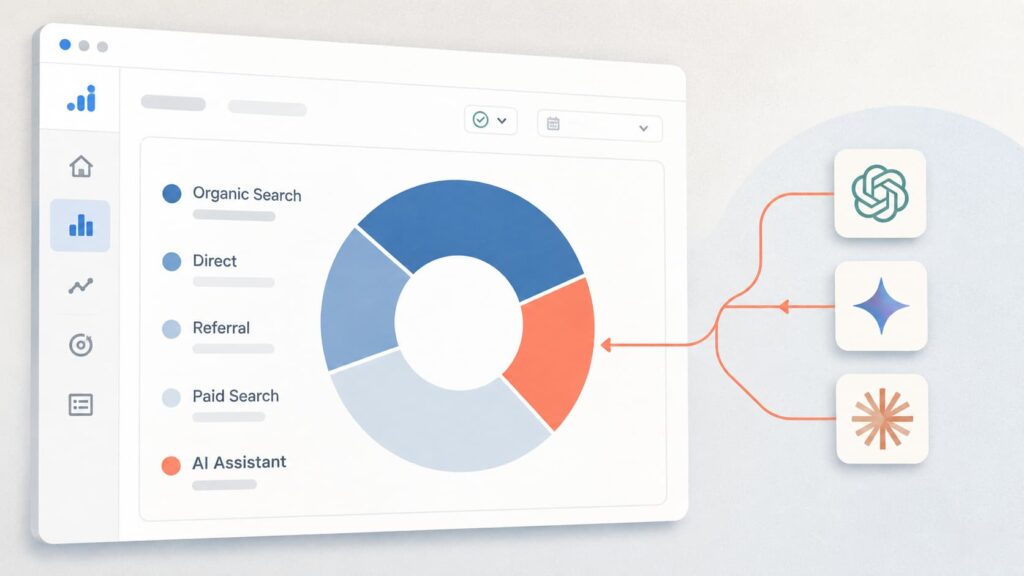
Google Analytics has added "AI Assistant" as a default channel group in GA4, automatically separating chatbot-referred traffic from the generic Referral bucket. This applies to traffic from recognized AI platforms including ChatGPT, Gemini, and Claude, with no manual setup required.
GA4 has been overdue for a native way to separate AI-referred traffic from everything else. For the past couple of years, sessions arriving from ChatGPT, Gemini, Claude, and similar platforms have landed in the Referral channel alongside press mentions, partner sites, and directory listings. That blunt grouping has made it genuinely difficult to size the AI traffic opportunity in any meaningful way. This update fixes that, and it is worth understanding exactly how.
What GA4 Actually Changed
The core mechanics here are more considered than a simple label rename. When GA4 detects a referrer matching a recognized AI assistant, it assigns “ai-assistant” as the medium value for that session. The session then surfaces under the AI Assistant channel in Default Channel Group reports. At the same time, the campaign dimension receives a reserved “(ai-assistant)” label.
In practice, this means the change touches three traffic-source dimensions simultaneously: source/medium, channel group, and campaign. That is not a cosmetic update. It is a structural reclassification that affects how these sessions appear across any report that uses those dimensions as a primary or secondary breakdown.
The AI Assistant channel is now part of GA4’s default channel-grouping system, meaning it shows up automatically for all GA4 property owners without any additional configuration. There is no separate cost and no toggle to switch on.
Why This Matters More Than It Looks
The most immediate practical consequence is that historical Referral numbers will look artificially inflated in retrospect, because AI chatbot sessions were previously counted there. Going forward, AI-referred traffic has its own lane, which makes trend analysis much cleaner.
The bigger story here is the referrer-attribution problem that this change acknowledges. AI chatbots have been sending meaningful traffic to websites for some time now, and the inability to distinguish that traffic at the channel level has been a genuine gap in standard reporting. Google has explicitly named ChatGPT, Gemini, and Claude as recognised AI assistants, but it has not published a comprehensive list. Perplexity, Copilot, Meta AI, and Grok are not yet confirmed in scope. If any of those represent meaningful traffic for you, the practical move is to audit your existing Referral channel for known AI sources that may still be falling outside the new AI Assistant grouping.
For anyone running acquisition reports regularly, the AI Assistant channel will now function as a primary dimension wherever Default Channel Group is supported. That means you can segment, compare, and build audiences against it using the standard GA4 toolset without any custom work.
What Happens to Custom Channel Groups You Already Built
If you set up a custom channel group specifically to catch AI chatbot traffic, this default channel does not automatically replace it. Custom channel groups continue to run alongside the native default, so there is no immediate breakage.
That said, if your custom setup was doing exactly what the AI Assistant channel now does natively, maintaining both creates redundancy and potential reporting confusion. The honest assessment is that most custom AI-traffic segments built as workarounds can now be simplified or retired in favor of the default. What the default channel cannot do is apply retroactively to historical data under the new classification; those past sessions remain wherever GA4 originally assigned them.
How to Actually Use This
The immediate action is straightforward: check your Acquisition reports and confirm the AI Assistant channel is appearing and populating. If you have been tracking AI referrals through a custom channel group or a manual segment, compare the two to understand how GA4’s recognized referrer list maps against what you were capturing independently.
Beyond that, this is a good moment to set up a dedicated comparison view: AI Assistant channel performance versus Organic Search and Direct, tracking engagement rate, session duration, and conversion rate by channel. Whether AI-referred visitors actually behave differently from other traffic is now testable rather than assumed; the clean channel data is what makes the comparison possible.
For anyone who has been ignoring AI traffic on the grounds that it was too small or too mixed into Referral to be worth segmenting, that justification no longer holds. The channel is there by default. Use it.
The Practical Verdict
If you run a GA4 property and receive any meaningful volume of traffic from AI platforms, this change belongs on your radar this week rather than next quarter. The feature requires nothing from you to activate, but it does require revisiting how your acquisition reporting is structured and whether existing custom segments are now redundant. It does not solve every AI attribution challenge, but it gives practitioners a clean, native way to track a traffic source that has been growing in relevance without a proper home in standard reports.