
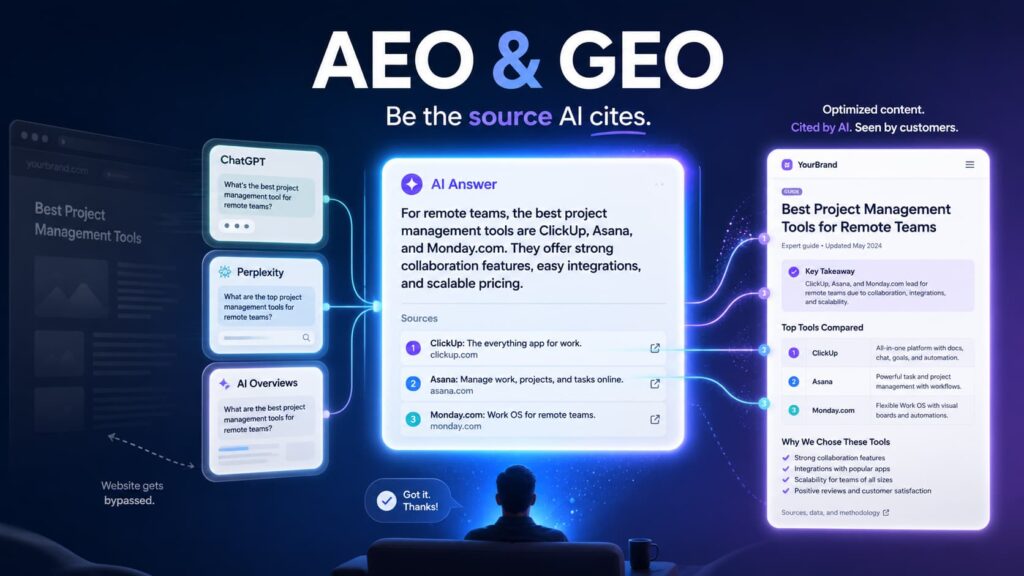
Answer engines like ChatGPT, Perplexity, and Google’s AI Overviews now settle your customer’s question before they ever open your website. Get cited in those AI answers and you are in the room; stay absent and, for that buyer in that moment, you simply do not exist. Answer Engine Optimization (AEO) and Generative Engine Optimization (GEO) are the disciplines for building that AI visibility on purpose, rather than leaving it to chance.
During the past two decades while working in online marketing, I have watched online visibility move through stages. First came ten blue links on a results page; then featured snippets and answer boxes that lifted a quick response above the list; and now a single answer an AI composes instead of presenting results at all. That shift now lands squarely on small and mid-sized firms, because your customers are researching with AI long before they ever speak to you. The good news is that the rules by which an AI decides to cite a business are no secret; you can understand them and you can influence them. So the question is not whether you should care, but how quickly.
What does it mean to be cited inside an AI answer?
To be cited means an AI answer engine pulls your business, product, or content into its answer as a source, linked or named. An answer engine is a system that answers a question directly instead of returning a list of links: ChatGPT, Perplexity, Google’s AI Overviews, Gemini, and Microsoft Copilot all qualify. The difference from classic search is not cosmetic but fundamental, because what stands at the end is no longer a selection but a verdict.
Answer Engine Optimization (AEO) is the work of getting your content into those direct answers. Generative Engine Optimization (GEO) pursues the same goal for generative systems that assemble their answer from many sources. Both terms describe the same shift: away from ranking a single page, toward being quoted inside an answer. Classic SEO makes sure people can find you; AEO makes sure they name you.
However, one does not replace the other. A business that is invisible in classic search is rarely cited by an AI either, because the same content is the raw material. AEO is therefore not a new building site next to the foundation; it is the next floor on top of it.
Why this matters now: your customers decide before they find you
The short answer: your buyers already use AI in the middle of their research, and they come to you only afterward. According to 6sense’s 2025 Buyer Experience Report, a survey of more than 4,000 B2B buyers across North America, EMEA, and APAC, 94 percent of buyers used large language models (LLMs) to summarize reviews or analyze data. What matters is the when: 6sense finds that buyers use LLMs mainly in the middle of their journey, not right at the start and not at the very end.
So what does that mean for you? By the time a prospect lands on your site, they do not arrive with an empty head but with an opinion an AI has already shaped. Picture a guest who turns up for dinner having read every review of the restaurant on the way over; your job is no longer to set the first impression but to confirm or correct one that is already formed.
This is exactly where AI visibility works either for you or against you. If the machine says the right thing about you, the buyer arrives half-convinced. If it says nothing, because it does not know you, then half the sales conversation happens without you, and a competitor leads it.
From the search box to the answer engine: what is shifting right now
Is this just another hype cycle? Four documented developments from the past months argue otherwise, and they come not from the marketing bubble but from analysts and the balance sheets of large vendors.
First, the direction of the software itself. Gartner predicts that by 2026 around 40 percent of enterprise applications will be integrated with task-specific AI agents, up from less than 5 percent before (Gartner, press release dated 26 August 2025). These agents will research, compare, and filter on the user’s behalf, and they will do it through the same answer layers where your visibility is decided.
Second, the money. In November 2025 Adobe announced its acquisition of Semrush for roughly 1.9 billion US dollars; the deal closed in April 2026. The rationale is the telling part, because Adobe’s own announcement puts brand visibility in the age of agentic AI squarely at the center. When a company of that size commits nearly two billion dollars to brand visibility inside AI systems, it is no longer a fringe topic.
Third, the analyst framing. In March 2026 Gartner published its Market Guide for Answer Engine Visibility Tools, recognizing a dedicated tooling category for visibility inside answer engines. What began as a buzzword now has a name, vendors, and evaluation criteria.
Fourth, the data on actual behavior. Conductor’s 2026 AEO/GEO Benchmarks Report analyzed more than 3.3 billion sessions across 13,770 domains and found that AI referral traffic accounts for an average of 1.08 percent of all website traffic. One percent sounds small, and honestly it is, measured by raw volume. However, that number is a leading indicator, not an end state; Conductor describes it as its own fast-growing performance channel, a signal of which businesses the systems trust enough to let into the answer. The value sits not in the click but in the influence before it.
How AI answer engines decide whom to cite
The short answer: AI answer engines favor content they can understand easily, attribute cleanly, and cite safely. Most of these systems work on a pattern called retrieval-augmented generation; put simply, the model pulls relevant passages from a body of sources and assembles its answer from them. A source that is easy to find, clearly structured, and trustworthy holds a structural advantage.
From that follows what a machine rewards. It rewards clear headings that visibly answer a question. It rewards a direct answer near the top rather than a long run-up. It rewards entity clarity, that is, a business that is named the same everywhere, described unambiguously, and corroborated by third-party sources. And it rewards verifiable claims backed by numbers and sources, because a machine can cite a concrete, attributable statement more safely than a vague one.
Worth noting is that the same qualities also serve a human reader. Writing for the machine is not writing against the person; it serves both. That is the genuinely good news here: AEO demands no tricks, only discipline in structure and substance.
What you can actually do to get cited in AI answers
The measures are less exotic than the term suggests. This is craft, applied consistently. The following seven steps form the core of what works in practice:
- Answer the question first. Put the actual answer in the first two or three sentences of a section before you elaborate. AI systems pull their excerpt preferentially from the top.
- Phrase headings as real questions. When your subheadings sound like the questions people actually ask, the machine finds the match faster.
- Build entity clarity. Make sure your business is named identically everywhere, has a substantive About page, and is described consistently across reliable directories, profiles, and data sources.
- Back claims with numbers and sources. A concrete, dated, attributed statement is cited more readily than an unsupported assertion; here, substance is also visibility.
- Be present where the AI sources its answers. Answer engines trust corroboration across multiple sources, so industry publications, review platforms, and reputable directories matter, not your own website alone.
- Use structured data and FAQ markup. Schema markup helps machines read your content correctly and lift individual answers cleanly.
- Keep content current. Facts about products, prices, and features age fast; stale figures are cited less often and reluctantly.
Expect no miracle from any single point. What works is the sum, and above all the consistency. A business that shows up clearly, evidenced, and consistently over months becomes the obvious, safe choice for a machine; and that is precisely the goal.
How to measure your AI visibility, and why most firms do not
You cannot improve what you do not measure, and almost nobody measures AI visibility systematically. The reason is mundane: it is tedious. You would have to put your buyers’ real questions into ChatGPT, Perplexity, and Google’s AI Overviews, check whether and how your business appears, record who gets named instead, and repeat all of it across several systems and over time, because the answers fluctuate.
This is exactly where most firms fall short, not for lack of will but for lack of method. An impression from a single query is worthless, because the systems do not answer the same way every time. You need a repeatable, comparable view: the same questions, the same competitors, several answer engines, a result you can act on. Only then do you see where you stand and where the biggest gaps are.
The next step: an AI Visibility Check
This is where the AI Visibility Check from MetaGem comes in. It is a fixed-scope, fixed-price assessment. It examines systematically how your business appears in ChatGPT, Perplexity, and Google’s AI Overviews, how that compares directly with your competitors, and where exactly you are not being cited when you should be. The output is not theory but a prioritized action roadmap: what to do first, what next, and what carries the biggest lever.
If you then want help with the implementation, you can move into an implementation retainer; it is not required. The check stands on its own and delivers value even if you work through it in-house.
A clear recommendation to close: if you run a small or mid-sized company whose customers increasingly prepare their buying decision with AI, AI visibility is no longer optional but part of the job; start with a measurement before you invest in fixes. If your market barely researches online, you still have some time, but keep an eye on the trend, because it is coming closer, not further away.
Want to know how your business shows up in AI answers today? Request an AI Visibility Check.
Frequently asked questions about AEO and GEO
What is the difference between SEO and AEO?
SEO makes sure your page is found in a list of search results; AEO makes sure your business is named in an AI’s direct answer. SEO targets the ranking of a page, AEO the citation inside an answer. Both build on the same content, which is why good SEO remains the foundation for good AEO.
Is AEO only relevant for large companies?
No, quite the opposite. Smaller and mid-sized companies benefit precisely because entity clarity and evidenced, well-structured content demand care rather than big budgets. A focused business with clear answers can stand ahead of a larger but muddled competitor inside an AI answer.
How quickly do you see results?
Honestly, not overnight. AEO works over weeks and months, because the systems build trust across multiple sources and over time. A first measurement shows the status quo immediately; visible improvements follow once consistent content and evidence take hold.
Do I have to give up my existing SEO?
Absolutely not. AEO does not replace SEO; it builds on it. Neglect your search fundamentals and you starve the AI of the very sources it would cite from. Treat AEO as the next floor on a foundation that stays in place.
How do I know whether my business currently appears in AI answers?
By putting your customers’ real questions into ChatGPT, Perplexity, and Google’s AI Overviews and recording systematically whether and how you are named. A single query is not enough, because the answers fluctuate; you need the same test across several systems and over time. That is exactly the work an AI Visibility Check takes off your hands.
What does an AI Visibility Check cost?
The check is offered at a fixed price so that scope and cost are clear from the start. You will find the exact price and what is included on the offer page once it is live; until then it is available on request.
About MetaGem
MetaGem is a consultancy for AI-driven marketing based in Germany. MetaGem helps small and mid-sized companies put AI to practical, results-oriented use, from visibility in answer engines through automation to chatbots and agents. The standard is substance over hype: what MetaGem recommends, it has understood and tested in practice.