Your team does not need another AI hype talk.
They need to know what is real, what applies to you,
and what the law now requires.
I bring 17+ years of hands-on experience across online marketing, e-commerce, team leadership, and practical AI. In that time I have done all of it hands-on: SEO, SEA, content marketing, and online shops from planning through implementation and management. Ever since artificial intelligence entered the scene, I have been working out the best ways to implement it within online marketing and e-commerce.
Clients and companies I worked for
What your team learns
Where they put it to work
You know AI matters. Nobody in the building can say what to do next, and it feels like the clock is running. These four sessions turn that worry into a sequence: leaders agree on a direction, the business picks its use cases, your people learn the method, and the organisation keeps the record.
Who this is for. Your staff already paste things into ChatGPT. Nobody has told them what is allowed, nobody owns the AI question, and you cannot tell whether competitors announcing AI projects are ahead of you or bluffing. If that sounds familiar, these sessions are built for you.
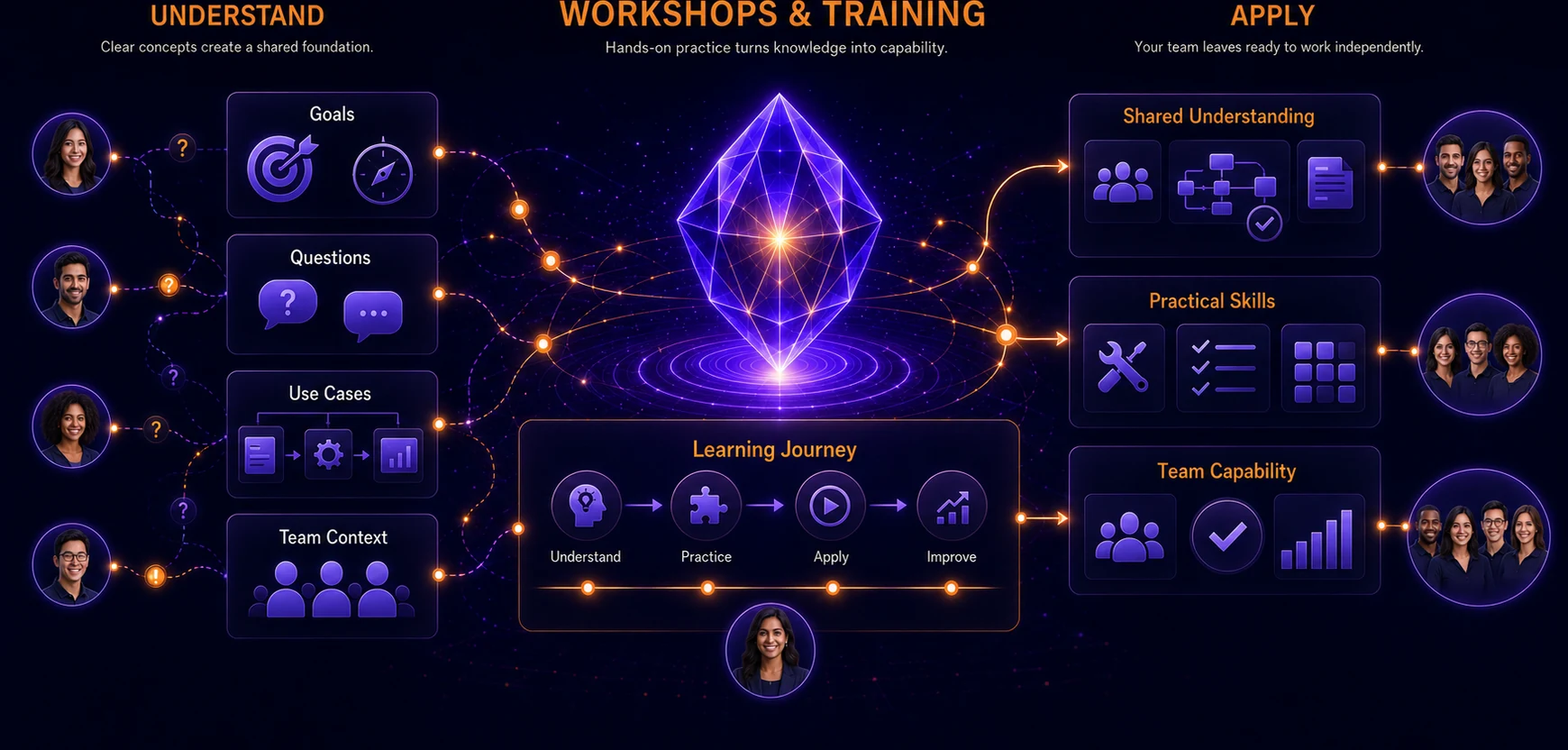
How the four fit together. The Briefing gives decision-makers one realistic picture. The Readiness Workshop turns it into a scored use-case list with owners. Practical Training equips the people doing the work. AI Literacy covers responsible use and leaves a documented record. Most companies need two of the four; the guide below picks them.
Your leadership cannot agree on what AI should do here. After this half day, you share one realistic picture, know where the risks sit, and leave with the two or three decisions worth taking this year.
See the briefing › Full dayIdeas are scattered across the business and nothing has priorities. After this day, you hold a scored roadmap of your own use cases, with an owner's name against every priority on it.
See the workshop › Hands-onLicences bought, results all over the place. After this training, your team works with a method: which tool for which job, how to ask, how to check the answer, and what never goes in. Practised on their own work.
See the training › DocumentedThe EU AI Act expects your staff to be AI-literate, and you have nothing on file. After this training, every role knows what it may and may not do with AI, and you hold the documented record.
See the training ›Buying the wrong session is the most common mistake here, and it is entirely avoidable.
Since February 2025 the EU AI Act expects staff AI literacy appropriate to their role. This session is built for that, with a documented curriculum and participation record. Operational training, not legal advice, an audit, or a certification of compliance.
Delivered in-house for a whole team, or one to one for an owner or team lead who wants to lead the shift themselves. In person, remote, or as a webinar.
Answer ten plain-language questions about how your people actually work with AI today. You get an immediate, honest assessment: what they can already do, where the gaps sit, and which training would change something rather than fill a day. Free, three minutes, no registration.
Take the skills checkRuns in your browser · nothing is transmitted · covers the Article 4 AI-literacy duty
Request a call. Tell us who uses AI today and what you are trying to achieve; you get a straight recommendation, including the case where the answer is none of the four.
Request a callIn-house or remote · built from your context · no obligation
Half a day that leaves your leadership team with a clear view of what AI can realistically improve here, where the risks sit, and which decisions are worth taking this year. Nothing technical required of anyone in the room.
A tailored half day for the people who decide where the money goes, built from your business rather than from a standard deck, that ends with one shared picture and two or three decisions worth taking this year.
Everybody in the room has read something different and none of it agrees. One article says AI changes everything, the next says it is a bubble, and neither is talking about your company. Meanwhile a customer asks what your AI strategy is, a department has quietly bought licences, and the most senior people present are the least able to admit they do not follow. Decisions get made on the strength of a press release. This session replaces that with one honest, shared picture.
A short intake first: what your business does, where the pressure is, what the leadership team actually argues about. The session is then built around exactly those questions. On the day we cover four things, with discussion running through all of them. Grounding, so you can tell apart what can be automated with confidence, what needs a person checking, and what will produce a convincing answer that is wrong. Examples from your sector in marketing, e-commerce and operations, including the ones that did not work. Risk and responsibility, covering data protection, confidentiality, what the EU AI Act already asks of you, and where human oversight has to stay regardless. Then the decisions, facilitated openly, and ended with something written down.
Management teams at the beginning of their AI thinking, who need everybody agreeing on the same facts before funding an audit, a workshop or an implementation. Six to a dozen people works best: small enough that everybody speaks, large enough that decisions stick. If your team is already aligned and needs concrete use cases scored, the AI Readiness Workshop is the better start. If you are looking for a motivational conference speaker, I am not your person.
Direct with me, no junior trainer, no account manager. Half a day, on site or remote, scope and price agreed before we begin. Nothing is being sold in the room and no tool is recommended for commission. What happens afterwards is your decision, and it is never assumed.
A day with the right people in one room, and a scored, prioritised roadmap at the end of it: which of your AI ideas are useful, which are feasible, and which are worth funding first.
A facilitated full day that turns the AI ideas already circulating in your business into a scored, ordered roadmap, with a named owner against every priority and an agreed next action.
Almost nobody arrives at this workshop short of ideas. What they are short of is a way to choose between them that survives a management meeting. Ideas sit in different heads with no common yardstick, so the ranking ends up decided by whoever argues hardest rather than by what is worth most. Leadership knows the strategy, the people doing the work know where the time actually disappears, and a list built from only one of those is reliably wrong.
Preparation happens beforehand, so the day itself is spent working rather than on introductions: company context, participant input and the questions your team is already arguing about. On the day we map what genuinely happens in the areas under discussion, including the workarounds, because that is where most of the real opportunities are found. Then structured use-case generation with the people who do the work, quantity first and judgement afterwards. Every candidate is then put through the same three questions, in the room, with the disagreements aired rather than smoothed over: what is it worth, in money or hours, with the assumptions on the wall where everyone can argue; can we actually do it, with the data, systems and people we have today rather than an idealised version of the company; and what has to be true first, meaning dependencies, approvals and the order they impose. That last question reorders most lists, because the highest-value idea is frequently the one that has to wait. The day ends with a sequence, a named owner per priority and an agreed next action. Without that last step the day is entertainment.
Companies with AI ideas scattered across the business and no agreed priorities, usually preparing a first implementation and wanting to be confident it is the right one. Eight to twelve people, mixed on purpose: somebody who can commit budget, the managers of the areas examined, and two or three people who do the work daily. Management-only workshops produce a list of things management wishes were true. If your leadership team is not yet aligned on the basics, the AI Briefing for Leaders comes first. If the question is specifically about marketing and e-commerce, the AI Marketing Audit gives you evidence rather than opinions in a room.
Direct with me, a full day, on site or remote, scope and price agreed before we begin. The facilitation is the product: anybody can run a brainstorm, the structure is what turns forty ideas into six scored candidates and one agreed start without the loudest voice deciding. Preparation is deliberately light, a short intake and brief written input; if preparing for a workshop becomes a project, something has gone wrong. The roadmap is written for your team to use, so if you never speak to me again it still works.
Your team leaves with a working method for AI, practised on examples from their own desks, and clear boundaries on where not to use it. In use the next morning, not filed away.
A hands-on session that gives your team a working method for AI, practised on examples from their own desks, with clear boundaries on where not to use it. In use the next morning, not filed away.
How it usually goes: licences for the whole department, a week-one burst of enthusiasm, and by week six two people use it constantly, three occasionally, and the rest opened it twice and went back to how they always worked. Nothing went wrong there, except that a tool was mistaken for a skill. Access to ChatGPT does not make somebody able to get reliable work out of it. The missing piece is method, and without it you are paying for licences you cannot tell are earning their keep.
Real examples are collected first: the monthly report, the product descriptions nobody enjoys, the customer replies that all say the same thing. Those become the exercises, so on Monday morning everyone already knows where to apply what they learned. Generic AI training fails predictably, because people watch an impressive demo of somebody else's job and cannot see where it applies to theirs. The session then covers seven things. Tailoring to roles and tools, because marketing, sales, service and operations do different work and need different examples. Effective prompting as a method, meaning how to ask, how to give context and how to iterate towards something usable, as principles rather than a list of phrases that will be obsolete next year. The tools themselves, ChatGPT, Claude or whatever your organisation has settled on, demonstrated on real tasks. Verification and human review, how to spot a confident and completely wrong answer and what must never be published unread. Confidentiality and responsible use, what may be entered into these systems and what may not, in plain workplace language rather than in policy prose. Hands-on exercises on participants' own tasks, because nobody has ever learned this by watching. And identifying repeatable workflows, so the training keeps paying after everybody goes back to their desk. Judgement gets as much time as technique: knowing when not to use these tools is a professional skill.
Teams that already have access to AI tools and are getting inconsistent results, in marketing, sales, service or operations, where people need practical competence rather than theory. Sessions are built for the real mix: a couple of confident users, several cautious, a few who never opened the tool. If what you need is documented AI literacy for an EU AI Act obligation, that is AI Literacy and EU AI Act Training, which includes a participation record. If your leadership has not yet decided what it wants from AI at all, start with the AI Briefing for Leaders. Developer training on building with these models is not what this is.
Direct with me, on site or remote, half day or full day depending on scope, agreed before we begin. Scoping first: roles, the tools already in use, current confidence levels and real work examples collected from the people who will attend. Standards are agreed in the room and written down before everybody leaves. Templates, the reference guide and a short list of workflows worth building next go with you, so the training does not evaporate by the end of the month.
Employees need to understand how to use AI responsibly, not merely which buttons to press. This EU AI Act training builds practical AI literacy role by role, explains the risks in language people recognise from their own work, and leaves your organisation with a documented record of what was taught and who attended.
Role-based AI literacy training that explains the risks in language people recognise from their own work, and leaves your organisation with a documented curriculum and an attendance record for the file.
AI arrived through the side door, one employee at a time, and no policy ever caught up with it. Your people already use these tools with your data, and most of them were never told what is safe. Since February 2025 the EU AI Act expects organisations to ensure staff have sufficient AI literacy for their role and context, and sufficient is not a checklist, which is uncomfortable and also the point. Worth saying plainly, because most providers omit it: the literacy expectation currently carries no penalty of its own. Anyone selling this training on the threat of an imminent fine is selling fear. The real reasons are duller and better, which is that people handling your data should know what they are handling, and that you should be able to show what you taught them.
The engagement starts with an assessment rather than a headcount: which groups use AI, in what way, with what data, and what level of understanding each role genuinely requires. Existing policies are read rather than assumed. Content is then built per user group, because marketing, sales, service, HR and management face different risks and need different examples. A session pitched to satisfy everyone is remembered by no one. Delivery is live, on site or remote, with role-relevant exercises rather than a lecture, because people remember what they practised. The training explains how these systems produce answers and why a confident answer can be entirely wrong; what may be entered into which tools, what must never be, and how to handle the awkward cases in between; where these systems fail unevenly, how to check output before it is used, and the situations that call for particular care. Everything is then documented: a written curriculum and an attendance record, handed over for your own file, so what was covered and who received it is a matter of record.
Organisations whose employees already use AI tools where no formal training has ever happened, or who are formalising responsible-use standards and want the training to match them. The right attendees are the people who use AI in their work and the people who decide how it is used, since drafting copy and applying AI in hiring need very different understanding. If you need a legal assessment of your obligations, that is work for a qualified lawyer and this is not a substitute for it. If you want a certificate declaring your organisation compliant, no such thing can honestly be issued.
Direct with me, on site or remote, scope and price agreed before we begin. This is operational AI-literacy and responsible-use training. It is not legal advice, a legal compliance audit, or a certification that guarantees compliance, and nobody can honestly promise the last of those, because compliance depends on how you use AI, your systems and your policies. What this delivers is role-appropriate literacy and documentation of what was covered, which supports your position rather than declaring it settled. Where the assessment finds a gap that training cannot fix, you hear it plainly.