Know what to do with AI before you spend on it

Practical
AI Consulting
for Companies

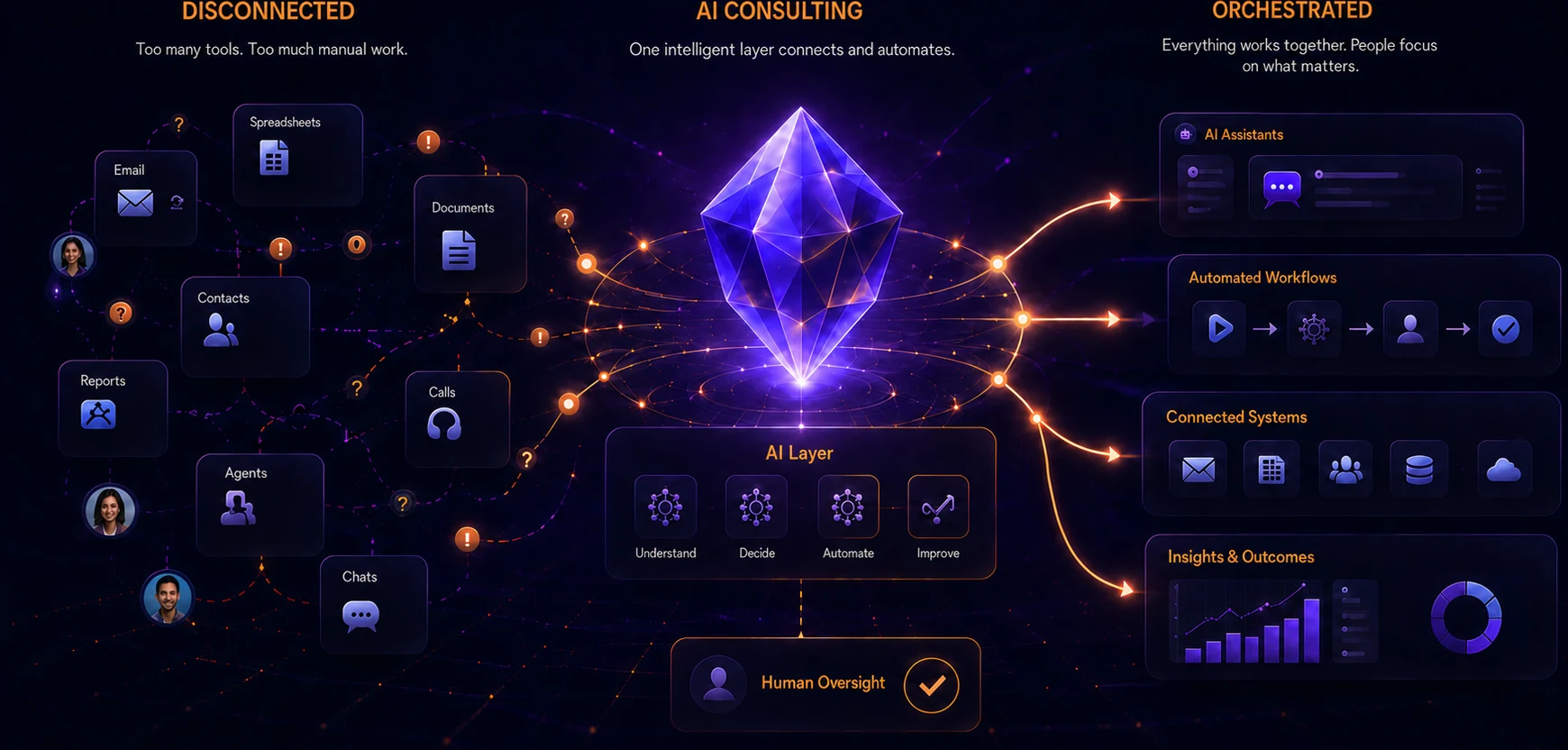
Identify where AI can create value, decide what to do first,
and move from a practical roadmap to implementation,
automation and team adoption.

Video call · free and without obligation
The Situation

Spending has started. Deciding has not.

Almost nobody arrives here from a standing start. They arrive with licences, pilots and opinions, and no way to compare any of them.

Three teams, three tools, no overviewMarketing bought one thing, service bought another, somebody in finance has a personal subscription. Nobody can say what any of it costs or returns.
Pilots that never became decisionsSomething was tried, it half worked, and it now sits in a folder because no one agreed in advance what would count as a result.
A list of ideas with no way to rank themEvery idea sounds plausible in a meeting. Without value, effort and risk on the same page, the loudest one wins rather than the best one.
Vendors answering a question you have not asked yetEvery supplier has exactly the product you need, which is difficult to evaluate before you know what you actually need.
Nobody owns itAI is everyone's project and no one's responsibility, so it advances in whatever direction the last enthusiastic person pushed.
Quiet legal exposureStaff are already pasting company information into tools nobody approved. That is usually discovered during a consulting engagement rather than before one.
The Work

What the engagement actually does

Four steps, in this order, because each one is worthless without the one before it.

Find the right use cases

Interviews plus a look at how work actually moves. You end up holding a shortlist of where AI genuinely helps in your business, the repetitive tasks, bottlenecks and decision delays, not a catalogue of the possible.

Rank value, effort and risk

Every candidate scored on the same three axes. After this step you can tell a cheap win from an expensive distraction at a glance, which is what separates a roadmap from a wish list.

Design the roadmap

You receive the plan itself: workflow, tools, who owns what, build order, and the number each step should move. Written so somebody who was not in the room can act on it.

Brief the first build

The top item leaves scoped and buildable: owner, success measure, human oversight, and what would count as stopping. Whoever builds it starts from a brief, not an ambition.

Deliverables

What you are left holding

Documents your team owns, in formats they can act on without me in the room.

Fit

Who this is for

An honest filter is cheaper for both of us than a wasted first meeting.

This is for you if

  • AI is already being used somewhere in the company and nobody has an overview of it.
  • You need an independent read before committing budget to tools or a supplier.
  • You have more ideas than capacity and need them in a defensible order.
  • You want a roadmap management can act on rather than a technology briefing.
  • Somebody will own the outcome afterwards, even if that person is you.

This is probably not for you if

  • You already know exactly what to build and want it built. Go straight to implementation.
  • Your question is specifically about marketing and e-commerce. The audit is the sharper instrument.
  • You want a document that justifies a decision already taken.
  • You are looking for enterprise IT transformation or custom model development, which is referred out.
Credibility

Who does the work

Seventeen years in marketing, e-commerce and digital operations, and daily production use of these tools. The useful part is not knowing every model; it is having run the processes being examined. That is what makes a recommendation actionable next week.

Nothing recommended is resold, no partner commission behind any tool named. Where a process should be fixed or stopped rather than automated, the roadmap says so.

What is not on offer: guaranteed savings, a transformation programme, or a number invented to justify the engagement.

Placeholder

A real client example belongs here. Left empty on purpose rather than filled with an invented story.

What Happens Next

The roadmap points somewhere

A prioritised list nobody builds is an expensive document. These are where the first item usually goes, and you are free to take it elsewhere.

If the question is specifically marketing and e-commerce, the AI Marketing Audit is the same method at narrower scope: fixed price, about three weeks, its own roadmap. Cheaper and sharper when you already know where the question lives.

If your people need to be able to use what gets built, that is Workshops & Training. Adoption decides whether any of it survives the first quarter.

FAQ

What companies ask before starting

How is this different from the AI Marketing Audit?

Same method, different scope. The audit looks at marketing and e-commerce; this looks across the company, including operations, service and internal work. A clearly marketing-shaped question wants the audit.

Do we have to implement with you afterwards?

No. The roadmap is written to be acted on by your team, another supplier, or nobody. Not a sales document with the answer withheld. Implementation is available, never a condition.

How long does it take?

A few weeks, not months, scope agreed before the start. Mostly interviews, watching how work moves, then the ranking. You are not occupied full time.

Who needs to be involved on our side?

Whoever knows how the work really happens, which is rarely the org chart. A handful of short conversations across the teams, plus one person with the authority to act on the result.

What if the honest answer is that we do not need AI here?

Then you will be told that, and where the money would do more good. A roadmap recommending stopping two things and starting one is a legitimate outcome, and cheaper.

Is what we tell you confidential?

Yes, including the embarrassing parts. The work depends on seeing how things actually run, which only happens when people can be honest without consequences.

Where do you stand?

The Seven Stages of AI Usage

Two people can use AI every day and get completely different value out of it. The difference is not talent, it is the stage you work at. Read down the ladder until you recognise yourself. Every engagement I run starts with exactly this question, and each stage below links the step that takes you one level up.

Quick Answers

You ask AI questions the way you used to ask Google, and you get faster answers. A quick explanation here, an email draft there, and the tab closes again. Useful minutes, nothing that carries over to tomorrow.

Deliberate Prompts

You have noticed that how you ask decides what you get back. You give context, set constraints, show an example of what good looks like, and you keep the prompts that work so you never start from zero twice.

Daily Driver

AI sits inside your working day, not next to it. You pick the right model for the job, you set up projects and instructions once and reuse them everywhere, and your results arrive faster than your colleagues expect.

Connected Workflows

You chain tools together and the first automations fire on a schedule instead of waiting for you. Research lands summarised, meeting notes write themselves, and part of your work now happens while you are somewhere else.

Your First Builds

You stop doing the tedious task and create the thing that handles it. Small internal tools and assistants, each scoped to one job, each running end to end, and each one freeing hours you used to lose.

Systems & Agents

You design systems instead of doing tasks. Agents hand work to each other, whole processes run under your supervision, and your job has quietly changed from producing the output to reviewing it.

The Self-Running Company

Your business runs on an AI workforce around the clock, and you spend your time only on the things only you can do. Nobody fully lives here yet. You are building toward it anyway, and so am I.

Most companies I meet are at stage one or two, with one enthusiast at three. That is normal, and it is exactly the gap this work closes: the audit finds your stage, the roadmap picks the next one worth reaching, and implementation, automation and training move you there. You do not need stage seven. You need the stage where your numbers change.

Start with the honest version

Request a call. Bring what has been tried, what is being considered, and the part nobody agrees on. You get a straight read on whether an engagement is worth it, including when it is not.

Request a call

Vendor-neutral · nothing resold · you own the roadmap

AI Implementation

Build One AI Solution That Earns Its Keep

The audit decides what to build and in what order. This is where it gets built, scoped to one measurable result, in weeks, not quarters. No open-ended projects, no "phase two we never reach."

One measurable resultWeeks, not quartersProven platformsYou own it

One high-value use case at a time, with defined KPIs and a result you can measure. We start small on purpose: prove it works, keep it if it earns its place.

What I build

Everything here is squarely in the marketing and e-commerce lane, the work where my judgment plus AI literacy is the advantage, delivered with proven, vendor-neutral tools rather than bespoke engineering.

  • Lead-qualification & nurture agents, score, route, and follow up automatically, wired into your CRM.
  • Content & SEO workflows, research-to-draft systems that scale output without losing the human edit.
  • Support chatbot, FAQ and order deflection on a proven platform, with clean handover to a human.
  • Private "your-docs" assistant, a RAG assistant over your own content, on off-the-shelf infrastructure.
  • Campaign & reporting automation, the repetitive marketing ops that quietly eat your team's week.

Framed in your numbers

Every build is defined by a commercial metric before we start: conversion, order value, tickets deflected, hours returned. Never model names. If we cannot name the number it should move, we do not build it.

Two ways in

Single build. One contained piece of work, for example a support chatbot or a lead-qualification flow, live in a couple of weeks. The lightest way to see a real result.

Full engagement. A fixed-scope 8-week engagement that takes a priority use case from the roadmap through to a working, measured solution your team can run.

What stays out

Custom model training, deep backend integration and enterprise automation are deliberately out of scope. Where a job needs heavy engineering, I say so and point you to someone who does it well.

Fixed scope, fixed price Measured against one KPI Vendor-neutral tooling No lock-in
What's Achievable

Documented at SME scale

Attributed results from published studies and other companies, what the approach is built for, not MetaGem's own results.

Support chatbot, ~2–3 weeks

A peer-reviewed micro-enterprise study saw average response time drop ~46% and satisfaction rise after a modest chatbot build, the realistic-scale proof point.

30–43% tickets deflected

SME benchmarks show well-built assistants deflecting a third to nearly half of routine tickets and cutting first-response time by 50–82%.

9.4% revenue from personalization

One e-commerce retailer reported a 9.4% revenue increase after adding AI personalization, the kind of lever a scoped first build targets.

Fit

Who this is for

An honest filter is cheaper for both of us than a wasted first meeting.

This is for you if

  • You know what outcome you want and need somebody to build the thing that delivers it.
  • An audit or a workshop has already named the priority and you are ready to move.
  • You want one scoped build rather than a transformation programme.
  • You need the result measured against a business number, not a demo.
  • You want to own what gets built, including the documentation.

This is probably not for you if

  • You want a proof of concept nobody intends to put into production.
  • The requirement changes every week and nobody will fix a scope.
  • You are looking for custom model training or deep backend engineering, which is referred out.
  • Nobody internally will own the thing once it is running.
Credibility

Who builds it

Seventeen years of marketing and e-commerce work, and daily production use of these tools. The person building understands the process being automated, which is where most technically correct but useless work comes from.

Everything is built on proven platforms in your own environment, and handed over documented. No licence you have to keep paying me for, and no system only I can maintain.

What is not on offer: guaranteed savings, an open-ended project, and a build that quietly never reaches production.

Placeholder

A real client example belongs here: the problem, what was built, and what it moved. Left empty on purpose rather than filled with an invented story.

FAQ

What teams ask before a build

How do you decide what to build first?

By value against feasibility, usually from an audit or workshop that already ranked them. Without one, the first conversation does a rough ranking: building the second-best thing well is worse than building the best thing adequately.

How long does a build take?

Weeks, not quarters, scope fixed before the start. If something cannot be delivered in that window, you hear it at scoping, not at the deadline.

What happens after launch?

A defined handover: documentation, a recorded walkthrough, training, a named owner on your side, and an agreed support period. Ongoing operation is available, never a condition.

Do you build custom AI models?

No. This is configuring and orchestrating proven platforms, which is what makes weeks and sensible cost possible. Custom model training and deep backend engineering get referred out.

Who owns what you build?

You do. It runs in your environment, on your accounts, with your data, and the documentation is written so somebody other than me can maintain it.

Build the right thing

The fastest way to a useful build is to start from the audit, so we build what actually matters first. Request a call and we will map it.

Request a call

Fixed scope · one measurable result · no lock-in

Related

What this works with

Workflow Automation

Automate Repetitive Marketing and Sales Work

One process, running itself the same way every time, inside the tools your team already uses. MetaGem maps it, builds it, and hands over the documentation and the controls so your people own it afterwards.

Your toolsYour environmentDocumentedHanded over
Plain English

What workflow automation actually means

Concrete, because the phrase means everything and nothing. Anna in your sales office: an enquiry arrives, she reads it, routes it, copies name and email into the CRM, sends an acknowledgement, adds a spreadsheet line for the report, sets a reminder to chase. Six steps, four minutes, thirty times a week, and every one a place something gets missed on a busy Friday.

Automation means writing those six steps down once, precisely, and having software perform them identically every time. Not AI deciding for you: a defined process running reliably, with a person holding every judgement that needs one. Anna stops being the copy-paste layer and goes back to the part that needs her.

The value is not the four minutes. The enquiry reaches the right person in seconds, the report is right because nobody transcribed it, and the follow-up happens whether anyone remembered.

The Situation

Where the hours actually go

None of these look serious on any single day. Added up over a year, they are usually somebody’s entire job.

Repetitive administration eating good peopleSkilled staff spending a chunk of every day moving information between systems that were sold to you as integrated.
Leads waiting for somebody to notice themAn enquiry arrives at 17:40 and reaches a salesperson on Monday. In a competitive market that gap is the whole deal.
Reports assembled by hand every monthTwo days of exporting, pasting and reconciling, producing a number that is already three weeks old by the time anyone reads it.
Content processes held together by copy and pasteBrief in one tool, draft in another, approval by email, publishing by hand. Every handover is a place where a version goes missing.
Automations nobody understandsSomebody built something clever two years ago and left. Now it runs, nobody knows how, and everyone is afraid to touch it.
Failures that never announce themselvesThe worst automations are not the ones that break loudly. They are the ones that stop working in silence and are discovered a month later, in the numbers.
Examples

The kind of work that gets automated

These are the ones that come up most often in marketing and sales teams. One of them is where we start, not all six.

CRM lead routing

Enquiries captured, enriched, assigned to the right person by rules you set, and acknowledged immediately, without anybody retyping a thing.

Email and lifecycle actions

Onboarding, follow-up, reactivation and post-purchase messages triggered by what a customer actually did rather than by a person remembering.

Content production handoffs

Brief to draft to review to publication, moving between your tools automatically, with the approval gates kept firmly in human hands.

Campaign reporting

Numbers pulled from every platform on a schedule and assembled into one report, so the monthly ritual stops costing two days.

Sales follow-up

Reminders, sequences and next-step tasks created automatically from what happened in the last conversation.

Data synchronisation

Two systems that were never designed to talk to each other, kept in agreement without a person acting as the bridge.

The Work

How MetaGem builds it

One workflow at a time, the first chosen for usefulness, not demo value. A single automation running reliably in production proves more to your finance director than a transformation programme with a steering committee.

Built in your environment with tools you already pay for. No new platform, no data leaving the country if that matters, nothing that stops working when the engagement ends.

The unglamorous half is error handling: the CRM is down, a field arrives empty, the form is submitted twice. Automations that ignore those fail silently, and silent failure is worse than the manual process it replaced.

  • Discovery and qualificationWhich processes are worth automating at all, and which ones should simply be abolished instead. Not every repetitive task deserves software.
  • Current-process mappingWhat actually happens today, step by step, including the undocumented workaround everybody uses and nobody mentions.
  • Automation designThe new process drawn out and agreed before anything is built, in your tools and your environment.
  • Build, integration and real-data testingConstructed and then run against your genuine data, because test data is always suspiciously well behaved.
  • Error handling and human review pointsWhat happens when something goes wrong, who gets told, and which decisions stay with a person by design.
  • Documentation, training and handoverA runbook, a recorded walkthrough and a trained team, so the workflow is yours rather than mine.
Deliverables

What you receive

Process

How it runs

Deliberately small. One workflow, proven, before anybody talks about the next five.

Select one workflow

We look at the candidates together and pick the one with the best ratio of value to complexity. Usually it is not the one people expect.

Map and design

The current process documented honestly, the new one designed and agreed, including where a human stays in the loop.

Build and integrate

Constructed in your environment, connected to the tools you already use, with permissions kept as tight as the job allows.

Test with real data

Run in parallel with the manual process until it earns trust, including the awkward cases everybody forgot to mention.

Document and hand over

Runbook, recording, training and named ownership. The engagement ends with your team in control, not dependent on me.

Fit

Who this is for

This is for you if

  • You are a small or mid-sized team losing real hours to repeatable marketing, sales or reporting work.
  • You want one controlled first automation rather than a transformation programme.
  • Leads, content or reports move between tools by hand and it shows.
  • You have automations already and nobody trusts them.
  • Data has to stay in your environment and you need somebody who treats that as a requirement rather than an inconvenience.

This is probably not for you if

  • You want twenty workflows delivered at once. That is how organisations end up with twenty things nobody maintains.
  • The underlying process is broken and the hope is that automating it will hide that.
  • Nobody internally is willing to own the workflow afterwards.
  • You are looking for a permanently outsourced operations team rather than a capability of your own.
Credibility

Who builds it

Seventeen years of marketing and e-commerce work, which matters because the builder understands the process being automated. Most disappointing automation is technically correct work by somebody who never ran the job.

The workflows discussed here run behind MetaGem itself: content production, research, reporting, publishing. Modest proof, but real, and why the recommendations include the awkward details, not only the happy path.

What is not on offer: a platform licence you have to keep paying me for, a workflow only I can maintain, and automation of a process that would be better simply stopped.

Placeholder

A real client example belongs here. Left empty on purpose rather than filled with an invented story.

FAQ

What teams want to know before they commit

Which tools can you connect?

Most common systems: CRMs, email and marketing platforms, shop systems, spreadsheets, form, project and content tools, anything with a reasonable interface. Genuinely closed systems get named early, not discovered mid-build.

Do you use n8n?

Often, yes: it runs in your environment and does not charge per task in a way that punishes success. But the tool follows the requirement. If your team already runs something else competently, build on that.

Can you work inside our environment?

Yes, and preferred. Your infrastructure and accounts avoid a new supplier dependency and keep data handling under your control, which matters for German and EU companies. Access is scoped as narrowly as the workflow allows.

What happens if an automation fails?

Designed for, not answered afterwards. Every workflow gets error handling, a route for anything it cannot process, and a notification so a human finds out immediately. The runbook covers what to check and how to fall back to manual.

Can we expand later?

That is the intended path. The first workflow is deliberately one useful one: your team learns what good looks like, management sees a result. Expanding afterwards is cheaper because the conventions and documentation already exist.

Start with one workflow

Request a call. Bring the process that annoys your team most, and we will work out together whether it is worth automating, worth simplifying, or worth abandoning altogether.

Request a call

Built in your environment · documented and handed over · no lock-in

Related

What this works with

Chatbots & AI Assistants

Answer the Repetitive Questions Without Adding Headcount

A working AI assistant on your site or in your support flow, built on proven platforms in weeks, not a six-figure custom project. Scoped to one job, measured against one number.

Customer serviceWebsite and salesCompany knowledgeClean human handover
Four Build Types

One bot, one job, one number

Each build targets a single KPI and ships as a fixed-scope engagement. Most arrive pre-scoped from an audit, so you build the one that actually pays back first.

Customer-Service Chatbot

Deflects routine support tickets (FAQ, order status, returns) on a proven platform, with clean handover to a human. KPI: percentage of tickets handled without a person.

Website / Sales Chatbot

Captures leads and answers product questions, conversion-oriented. KPI: leads captured and conversion lift.

AI Agent

Takes actions, not just answers: checks a calendar, books, updates the CRM. KPI: process steps automated.

Company GPT / Private Docs Assistant

An internal assistant trained on your own documents (RAG), private to the company. KPI: time saved on internal lookups.

How the build works

A fixed-scope engagement: one bot, one defined job, one measurable result. We map the target, build and train on a proven platform, wire the integrations, run it on a contained set first, measure, and tune before widening.

The honest boundaries

  • Platform-based, not from scratch, I configure and orchestrate proven tools (chatbot platforms, n8n, a GPT layer, RAG), not custom model training or deep backend engineering.
  • That boundary is the pricing logic, platform work is solo-deliverable at this price; custom development gets referred out or partnered, openly.
  • The maintenance tail is handled up front, every build either includes a defined handover (you own and maintain it) or rolls into a Managed Operations retainer. Never an unmaintained bot left running in your name.
  • Scope discipline, one bot, one KPI, one platform per engagement. Extra capabilities are additional scoped builds, not creep.
Proven platforms, no risky custom dev DSGVO-native hosting Fixed price I build it, you own it
What's Achievable

Documented at SME scale

Attributed results from published studies and other companies, what the approach is built for, not MetaGem's own results.

~46% faster responses

A peer-reviewed micro-enterprise study saw average response time drop around 46% and satisfaction rise after a modest support-assistant build.

30–43% tickets deflected

SME benchmarks show well-built assistants deflecting a third to nearly half of routine tickets and cutting first-response time by 50–82%.

~4× conversion when engaged

Shoppers who engage in a chat convert at roughly four times the rate of those who do not, so a sales bot doubles as a revenue surface.

Fit

Who this is for

An honest filter is cheaper for both of us than a wasted first meeting.

This is for you if

  • The same questions arrive over and over, from customers or from your own staff.
  • Support volume is rising faster than the team can absorb.
  • You have a body of content or documentation that already holds the answers.
  • You want one bot doing one job well rather than a platform nobody configures.
  • You care that the handover to a human is clean rather than a dead end.

This is probably not for you if

  • You want a bot to replace your support team outright.
  • There is no content for it to answer from and nobody will write any.
  • You expect it to handle every question with no escalation path.
  • Nobody will own it once it is live, which is how bots quietly rot in production.
Credibility

Who builds it

Seventeen years of marketing and e-commerce work, building on proven platforms rather than from scratch. That boundary keeps delivery in weeks: configuration and orchestration, not custom model training.

The maintenance tail is the real risk, so it is decided at scoping: a documented handover to your team, or an agreed ongoing arrangement. An unmaintained bot with your name on it is worse than no bot.

What is not on offer: a bot that answers everything, guaranteed deflection rates, and a system that breaks the week after the invoice clears.

Placeholder

A real client example belongs here. Left empty on purpose rather than filled with an invented story.

FAQ

What companies ask before building one

What can it actually answer?

Whatever your content covers: product questions, orders and returns, documentation, internal process. It answers from your material, not general knowledge, which keeps it accurate and stops invented answers.

What happens when it does not know?

It says so and hands over. Escalation rules are agreed before the build, including what it may never attempt. A confident wrong answer costs more than an honest handover.

Which platform do you use?

Whichever fits the job and your data requirements, chosen at scoping rather than in advance. The work is platform configuration and integration, so the choice follows the requirement instead of leading it.

Where does our data go?

Settled before anything is built; for German and EU companies it usually decides the platform. Hosting, retention and what leaves your environment are scoping items, not afterthoughts.

Can it do more than answer questions?

Yes, the agent end of the range: checking a calendar, creating a ticket, updating a record. Each action is a scoped extension with its own testing, because an assistant that acts deserves more care than one that talks.

Ship one that earns its place

Request a call. We will pick the one bot worth building first and define the number it should move.

Request a call

Proven platforms · fixed price · DSGVO-native · you own it

Related

What this works with