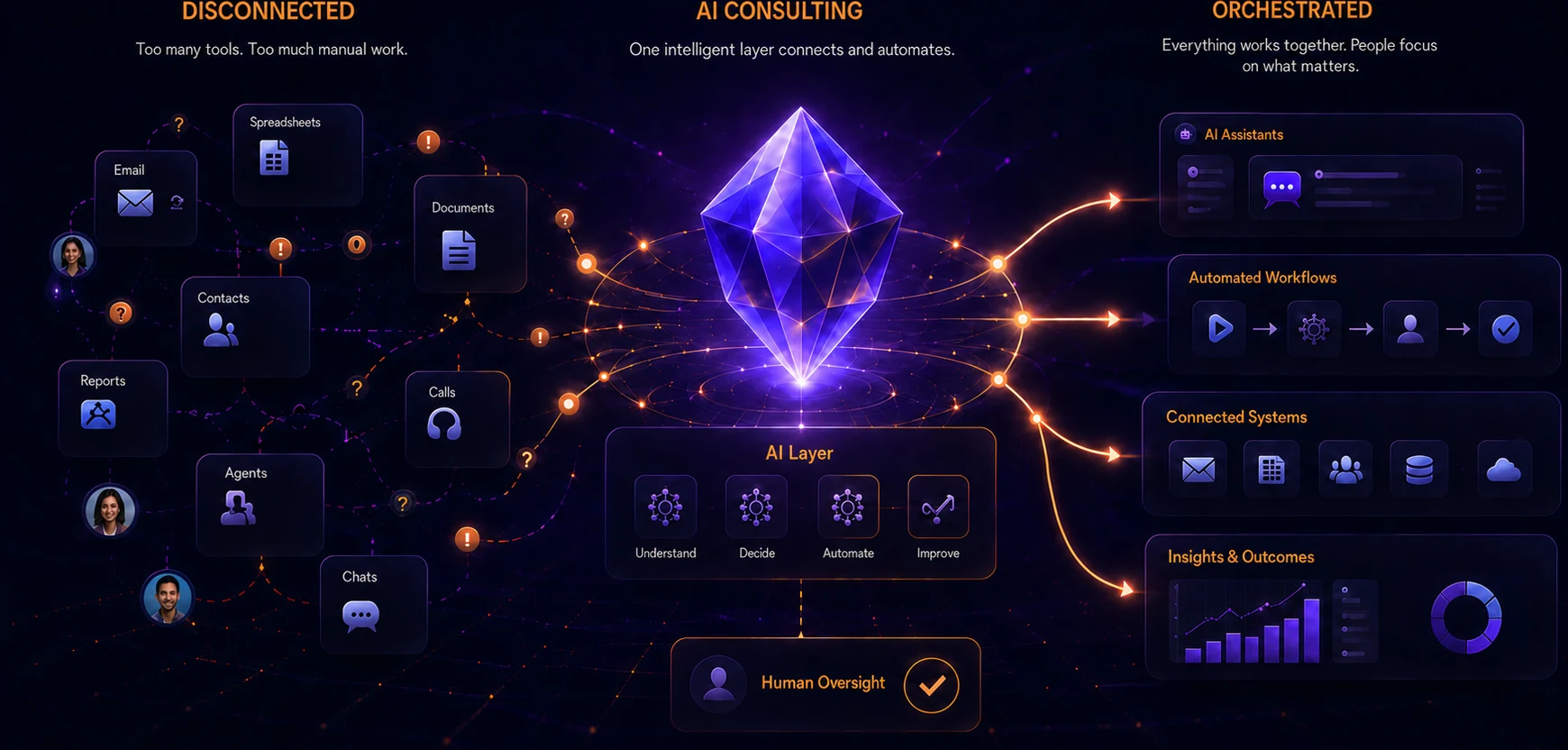
Identify where AI can create value, decide what to do first,
and move from a practical roadmap to implementation,
automation and team adoption.
Almost nobody arrives here from a standing start. They arrive with licences, pilots and opinions, and no way to compare any of them.
Four steps, in this order, because each one is worthless without the one before it.
Interviews and a look at how work actually moves, to surface the repetitive tasks, information bottlenecks and decision delays where AI could genuinely help. Not a catalogue of what is possible, a shortlist of what applies here.
Each candidate scored on the same three axes, so an expensive distraction and a cheap win stop looking alike on a slide. This is the step that separates a roadmap from a wish list.
The workflow, the tools, who is responsible for what, the order of implementation and the number each step is supposed to move. Written so somebody who was not in the room can act on it.
The top item scoped properly: owner, success measure, human oversight, and what would count as stopping. Whoever builds it, they receive a brief rather than an ambition.
Documents your team owns, in formats they can act on without me in the room.
An honest filter is cheaper for both of us than a wasted first meeting.
Seventeen years in marketing, e-commerce and digital operations, and daily use of these tools in production rather than in demonstrations. The useful part is not knowing every model on the market. It is having run the kind of processes being examined, which is what makes the difference between a technically correct recommendation and one somebody can act on next week.
Nothing on the recommendation list is resold, and there is no partner commission behind any tool named. Where the honest answer is that a process should be fixed or stopped rather than automated, that is what the roadmap will say.
What is not on offer: guaranteed savings, a transformation programme, or a number invented to justify the engagement.
A real client example belongs here: the starting situation, what the ranking changed, and what got built first. Left empty on purpose rather than filled with an invented story.
A prioritised list nobody builds is an expensive document. These are where the first item usually goes, and you are free to take it elsewhere.
One useful AI solution, scoped to a single measurable result and delivered in weeks. The broadest of the three, and the right one when the answer is not obviously a workflow or a bot.
See the service › Repetitive tasksThe repetitive work that moves information between your tools. Mapped, built in your own environment, documented, and handed to your team rather than kept hostage.
See the service › Repetitive questionsThe repetitive questions, from customers or from your own staff, answered from your own content on proven platforms, with a clean handover to a human when it matters.
See the service ›If the question is specifically marketing and e-commerce, the AI Marketing Audit is the same method at a narrower scope: fixed price, about three weeks, ending in its own prioritised roadmap. It is the cheaper and sharper instrument when you already know which part of the business the question lives in.
If your people need to be able to use what gets built, that is Workshops & Training. Adoption is the step most roadmaps forget, and the one that decides whether any of it survives the first quarter.
Same method, different scope. The AI Marketing Audit looks at marketing and e-commerce specifically. This looks across the company, including operations, service and internal work. If your question is clearly a marketing question, the audit is the cheaper and sharper instrument.
No. The roadmap is written to be acted on by your own team, another supplier or nobody at all. It is not a sales document with the answer withheld. Implementation is available and is never a condition.
A few weeks of elapsed time rather than months, and the scope is agreed before it starts. Most of that is interviews, looking at how work actually moves, and then the ranking. You are not occupied full time while it runs.
Whoever knows how the work really happens, which is rarely the same people who own the org chart. Typically a handful of short conversations across the teams involved, plus one person with the authority to act on the result.
Then you will be told that, and where the money would do more good instead. A roadmap that recommends stopping two things and starting one is a legitimate outcome, and considerably cheaper than the alternative.
Yes, and that includes the parts that are embarrassing. The work depends on seeing how things actually run rather than how they are supposed to, which only happens when people can be honest without consequences.
Request a call. Bring what has already been tried, what is being considered, and the part nobody can agree on. You will get a straight read on whether an engagement is worth it, including the case where it is not.
Request a callVendor-neutral · nothing resold · you own the roadmap